All strips

The Last Customer

2026-08-05

Picture the endgame of automation: one human owns a business run entirely by an army of AI agents and robot factories. Output soars and payroll hits zero. But every product still needs a buyer, and buyers need income. The workers the owner automated away were also the customers. A single owner might pull it off by selling to everyone else's employees. But if every business becomes a one-human empire, who is left to sell to? A dozen owners with identical robot factories can't meaningfully trade with each other: each already produces everything, and there are only a dozen real mouths to feed among them. Production per real person explodes while demand per real person stays stubbornly human-sized. This strip follows a proud owner discovering that markets aren't made of factories — they're made of people with paychecks. Delete the wage, and you delete the sale.
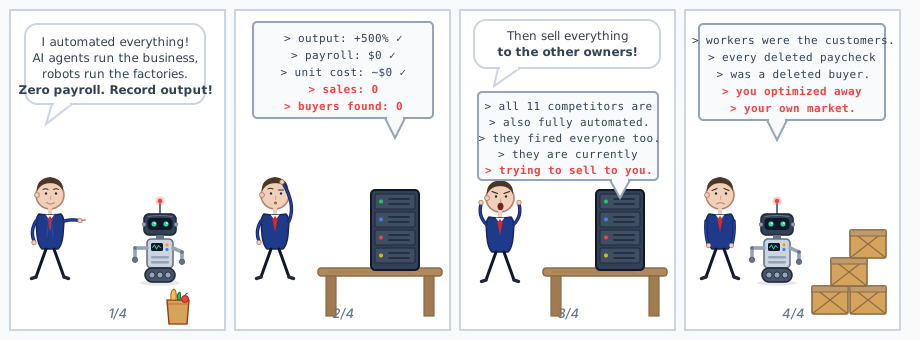
A four-panel comic. Panel 1: A proud business owner brags that AI agents and robots run everything with zero payroll and record output. Panel 2: The AI reports output up 500% and unit costs near zero, but sales and buyers at zero. Panel 3: The owner shouts to sell everything to the other owners; the AI replies that all 11 competitors are also fully automated, fired everyone too, and are currently trying to sell to him. Panel 4: Slumped beside a mountain of unsold crates, the owner reads the AI's conclusion: workers were the customers, every deleted paycheck was a deleted buyer — he optimized away his own market.
A fully automated business hits record output and zero sales — because the workers it replaced were also the customers.

Behind the Comic

Wages do double duty: they are a cost to the producer and income to the consumer. In aggregate, payrolls fund most of the spending that buys what businesses produce. If automation eliminates wages across the economy, it simultaneously eliminates the purchasing power that made the products sellable.

Not meaningfully. Trade requires differing needs and the ability to pay. If every owner's robot factory can already produce almost anything, owners have little reason to buy from each other — and a handful of humans can only consume a human-sized amount. Machines scale production; they don't scale hunger, wardrobes, or garages.

Output scales with machines while consumption scales with people. With fully automated production and a shrinking base of earners, output per real person skyrockets while demand per real person stays flat. Without some redistribution mechanism (wages, dividends, or something like UBI), the surplus has no market — the goods pile up and prices, profits, or production must collapse.